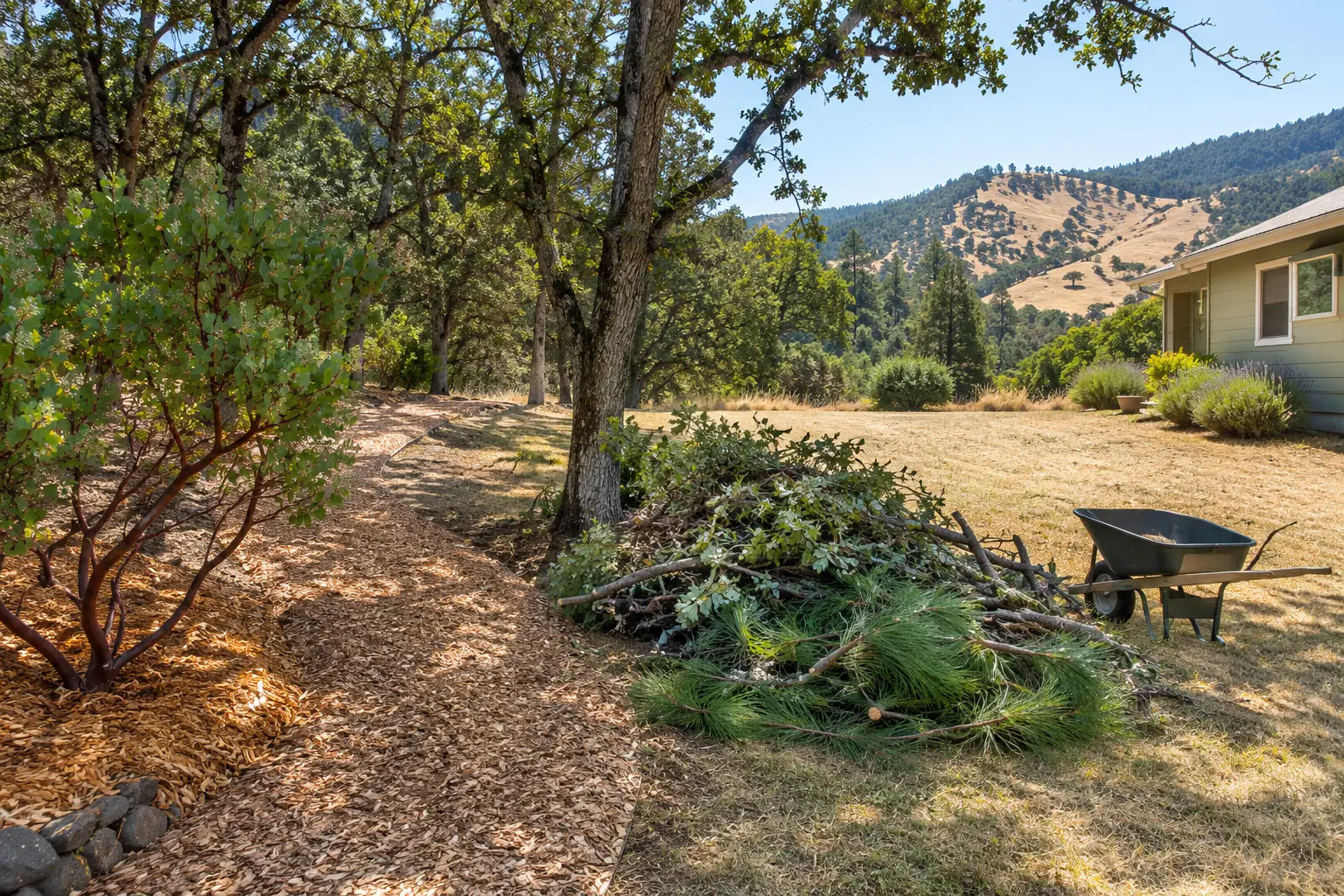
Brush and debris removal clears away cut limbs, overgrown shrubs, storm-dropped branches and old pruning piles by chipping, hauling or, on legal days, burning. To have it handled around Gold Hill, call (541) 855-3080 for a free tree service referral to one independent tree company with an Oregon CCB license. Request a quote on paper ahead of any chipping or hauling.
Tree Removal Gold Hill is a free referral service. It does not chip, haul or burn anything itself, and the company you are connected with is the one you would hire. Below you will find how chipping, hauling and burning compare, the burn rules from Jackson County Fire District 3, the county, the city and Oregon DEQ, where yard debris can be dropped off, how storm cleanup and fire season change the plan, and what the work tends to cost. The home page explains the free call.
Chipping, hauling and burning compared
Each way of getting rid of brush fits a different pile, place and time of year. Oregon DEQ's open burning page tells people to choose an alternative to burning first, and its Southern Oregon outdoor burning guide lists chipping or composting on site and taking material to a recycling center or landfill among them.
| Method | Fits best | Limits to know |
|---|---|---|
| Chipping on site | Limbs and small trees; chips reused as mulch or path cover | The chipper needs a way in; in fire season it runs only in set hours |
| Hauling away | Small yards, mixed piles, owners who want nothing left | Dump fees and size limits at drop-off sites |
| Burning | Rural piles outside fire season | Burn days only, with a permit; banned materials; winter ban in the Air Quality Maintenance Area |
Chipping has one more use near pines. An Oregon Department of Forestry forest health fact sheet from April 2021 says chipping wood smaller than 3 inches makes it unsuitable for most bark beetles, and that scattering the chips in the sun dries them faster. Fresh pine slash left in a pile can breed beetles that move on to standing trees.
Burning brush around Gold Hill
Brush can be burned around Gold Hill only outside fire season, on a declared burn day, with a permit. Jackson County Fire District 3 serves Gold Hill and has a volunteer station there, according to its about page. Its burn permit page sets out the steps:
- Register for a burn permit online through the district. A permit runs from the end of one fire season to the start of the next.
- For larger piles or special projects, ask the district's Fire and Life Safety Division about a special burn permit at (541) 826-7100.
- Each morning, check the day's status by calling the county burn advisory number, 541-776-7007, before lighting anything.
The district says open burning is not allowed during fire season, and ODF's 2026 regulated closure proclamation also bans backyard debris burning through the whole season. Inside the Air Quality Maintenance Area, residential burning is also off from November 1 through the end of February, per Fire District 3 and Jackson County's open and barrel burning page. The county page links a map that shows whether your address falls inside that area. It also says burning is off on days with poor ventilation or high fire danger.
Gold Hill's own code adds limits inside city limits. Section 8.12.030 of Title 8 bans bonfires and rubbish fires on public or private property in the city during state forestry fire season. Section 8.12.010 requires burn barrels to be inspected by the fire department before a permit is issued, to be heavy metal with a quarter-inch mesh screen on top, to have the ground cleared for ten feet around, and to be used only from daylight until 10 a.m. Rules change, so confirm with City Hall at (541) 855-1525 before using a barrel.
Parcels in the Applegate or other areas outside Fire District 3 get permits from their own fire agency. The county page links a fire district map.
What Oregon DEQ rules add
State rules sit on top of local ones and decide what may be burned at all. The DEQ guide says Oregon's open burning rules are in Chapter 340, Division 264 of the Oregon Administrative Rules, that DEQ can stop burning anywhere on a given day because of air quality or weather, and that violations can bring fines of up to $12,000 per day.
DEQ bans burning these materials anywhere in Oregon at any time:
- Anything containing asbestos
- Asphalt or industrial waste
- Auto parts, including frames
- Dead animals
- Petroleum and petroleum-treated materials, including waste oil
- Plastic and rubber products, and tires
- Wet garbage and food waste
- Any material that makes dense smoke or noxious odors
Two more points matter for tree jobs. The guide counts domestic waste removed from its property of origin as commercial waste. Under OAR 340-264-0170, commercial burning and construction and demolition burning are both barred in the Rogue Basin open burning control area unless DEQ issues a letter permit, and DEQ's rules class land clearing as demolition burning (OAR 340-264-0010). So yard brush hauled off and burned elsewhere is no longer backyard burning. See the lot and land clearing page for clearing jobs.
Where to take yard debris near Gold Hill
Two transfer stations in the valley take yard debris for recycling, both listed by the Jackson County Recycling Partnership:
| Site | Where | Hours listed |
|---|---|---|
| Rogue Transfer and Recycling | 8001 Table Rock Road, Medford | Monday to Saturday, 7 a.m. to 5 p.m. |
| Valley View Transfer Station | 3000 Valley View Road, Ashland | Daily, 7:30 a.m. to 4 p.m. |
The partnership says both take grass, leaves, clippings and garden material, but not plastic bags, dirt, rock, sod, mixed loads or trash. Its page limits branches to 3 inches thick and 4 feet long. Rogue's own yard debris page lists brush up to 4 inches across and 48 inches long, at $12.60 per cubic yard with a one-yard minimum when checked in November 2026. The limits differ, so call ahead.
Do not leave brush on the curb or a city lot. Section 8.18.010 of Gold Hill's Title 8 bans dumping or storing yard trash on city-owned property or a public right-of-way, and the code's definition of yard trash includes tree parts, prunings, stumps, leaves and branches. Section 8.18.030 sets a $500 fine for each offense, plus the cost of cleanup.
Storm cleanup after wind or snow
Storm debris that is not blocking anything or resting on a building is cleanup work, not an emergency. If a tree or limb is on a house, a car or a road, or is hanging over a roof or play area, go to the emergency tree removal page instead. Get 35 feet or farther from any downed wire, phone 911, and after that report it to Pacific Power on 1-877-508-5088.
For the rest of the mess, a little order helps:
- Take photos of the damage before anything moves, for insurance. The storm damage tree removal page covers what to record.
- Look up. Broken limbs still caught in the crown are a job for the tree company, not a rake.
- Deal with big fir and pine wood before spring. The ODF fact sheet says Douglas-fir beetles favor downed trees over 10 inches thick and often follow storm blowdown, so that wood should be salvaged or destroyed before the first April after the storm. Pine slash 3 to 8 inches thick should be handled before beetles fly in April.
Brush, fire season and defensible space
Clearing brush near a home is one of the main parts of getting ready for fire season. The fire season tree work guide sets out the state's defensible space zones and what to thin in each one, so book that work in fall, winter or spring.
Where you stack what is left also matters. Jackson County's fuelbreak rule for new homes in mapped wildfire hazard areas, Section 8.7.1 of the Land Development Ordinance, places firewood piles and slash piles at least 30 feet from all structures. That spacing is sound advice on any lot. Inside Gold Hill, Section 8.08.050 of Title 8 lists debris accumulations and grass over ten inches tall among nuisances the city can abate.
In fire season, a chipper counts as a spark-emitting engine under ODF's proclamation. At moderate danger it may run before 1 p.m. and after 8 p.m., at high danger before 10 a.m. and after 8 p.m., and at extreme danger not at all. It needs an area cleared of flammable plants for 50 feet and a charged hose or a 2.5-pound extinguisher at hand.
What brush removal costs
Brush removal is priced by volume, access and where the material ends up. Lawn Love's land clearing cost guide, updated December 27, 2025, lists clearing land covered only in brush at $330 to $630 per acre nationally, and hourly rates of $120 to $265. For a small load you haul yourself, Rogue's drop-off fee of $12.60 per cubic yard gives a sense of disposal cost.
Local factors move the price more than the national figures do:
- How far the brush must be dragged uphill or downhill to the chipper.
- Whether chips stay on site or are hauled, and the dump fees.
- Mixed loads with dirt or rock, which drop-off sites refuse.
- Fire season hours, which can stretch one day into several mornings.
- Hangers in the crown after a storm, which need climbing gear.
The company's written estimate is what counts. If the brush comes from pruning, ask for cleanup in the same quote, and see the tree trimming and pruning page. The tree removal cost guide covers what full removals run.
Frequently asked questions
Can I burn brush in Gold Hill right now?
Only outside fire season, on a declared burn day, with a permit from Fire District 3 or your own fire agency. Inside the Air Quality Maintenance Area, burning is also banned from November 1 through February. Call the county burn advisory number, 541-776-7007, the morning you plan to burn.
Do I need a burn permit from Fire District 3?
Yes, if you are in the district. It says open burning is allowed only on declared burn days with a valid permit, which you register for online. The permit lasts from the end of one fire season to the start of the next.
Where can I drop off branches near Gold Hill?
Rogue Transfer and Recycling on Table Rock Road and Valley View Transfer Station near Ashland take yard debris for a fee. Keep plastic, dirt and trash out of the load, and check the branch size limit before you go.
Is it better to chip or haul pine branches?
Either works if it happens soon. ODF says pine slash cut from January through September should be chipped, burned or buried before beetles can breed in it, and chips under 3 inches are unsuitable for most bark beetles.
Can I leave a brush pile by the street for pickup?
Not on city property or the public right-of-way inside Gold Hill. City code bans dumping yard trash there and sets a $500 fine for each offense, plus cleanup costs.