
For one tree, 2026 cost guides land anywhere from a few hundred dollars to roughly $2,000, and urgent jobs climb past that. Around Gold Hill, slope, river setbacks and access move the price a lot. Call (541) 855-3080 to reach a CCB-licensed tree company, and treat its written estimate as the real number.
Tree Removal Gold Hill is a free referral service. It does not set prices, does no tree work and takes no payment from you. The company you are connected with gives the estimate, and you agree a price directly with it. This guide gathers the published price ranges, with their sources and dates, and explains what makes tree removal in Gold Hill cost more or less than those averages. For the basics of how the service works, see the home page.
Published tree removal price ranges
National cost guides group prices by tree height. Two are compared below, each labeled with the day its page was most recently revised. These are national figures, not quotes for Gold Hill.
| Height of the tree | Lawn Love (revised October 5, 2026) | This Old House (revised March 5, 2026) |
|---|---|---|
| 30 feet or shorter | $285 to $435 | $150 to $450 |
| Between 30 and 60 feet | $435 to $870 | $450 to $1,200 |
| Between 60 and 80 feet | $870 to $1,160 | $800 to $1,500 |
| Taller than 80 feet | $1,160 to $2,000 | $1,000 to $2,000 |
| Emergency job | $450 to $3,000 | Up to $5,000 |
| Average nationwide | $850 | $906 |
Figures come from the Lawn Love tree removal cost guide and the This Old House tree removal cost guide. Lawn Love lists a typical range of $385 to $1,070. This Old House lists a typical range of $820 to $992.
For stumps, LawnStarter's stump grinding cost guide, updated October 5, 2026, gives a national average of $272 per job and a typical range of $131 to $438.
Prices change, and the guides above do not survey Gold Hill companies. Only a quote written up after someone has looked at your tree counts as a real price.
What raises the price on a Gold Hill job
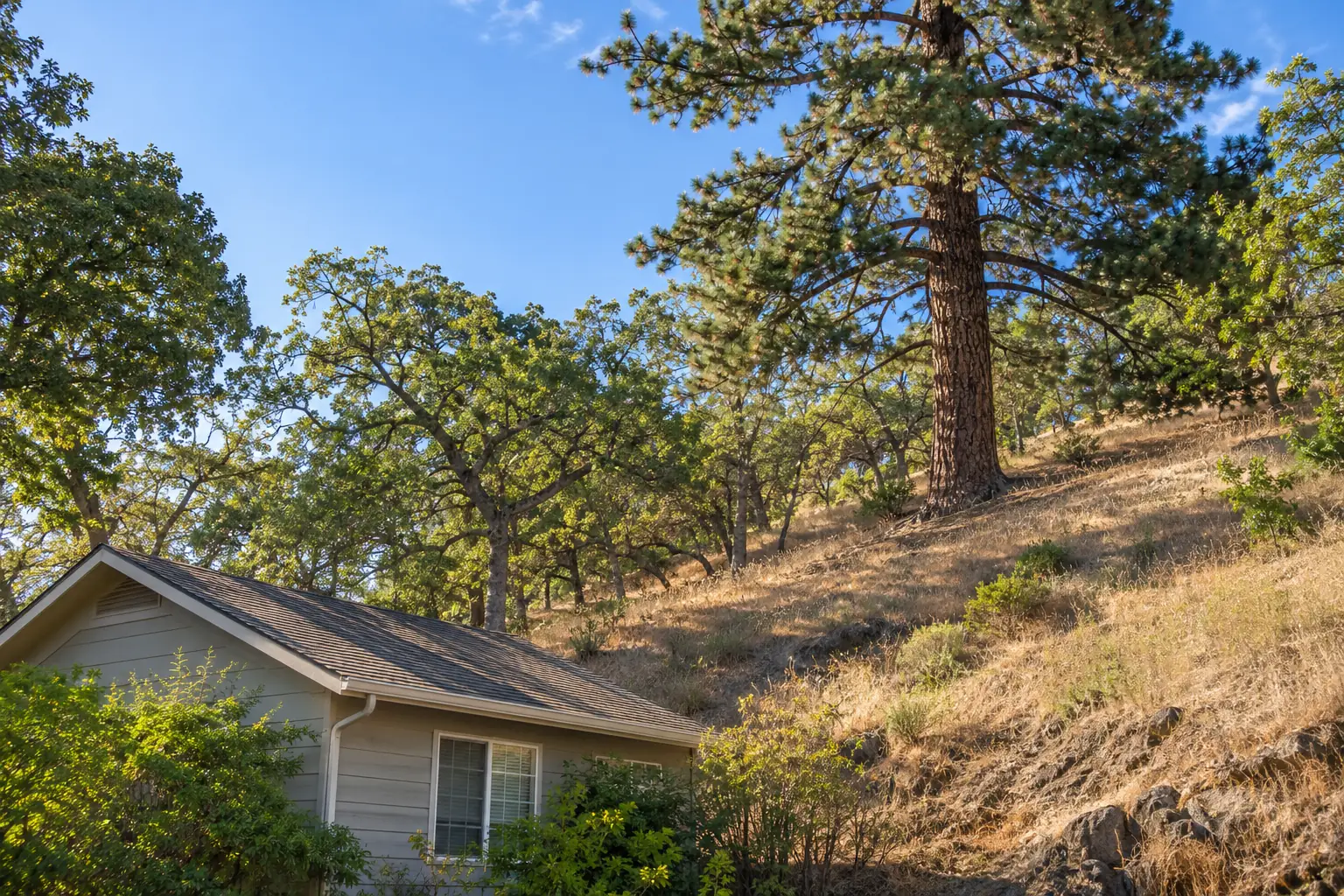
The biggest cost drivers here are access, slope, and what sits under the tree. Height matters, but a short tree in a hard spot can cost more than a tall one on open ground. This Old House lists accessibility, steep slopes, and trees near houses, power lines or fences among the factors that raise cost.
Slope. Many lots in and around Gold Hill climb from the river and valley floor. On a steep lot, wood has to be roped down, equipment may not reach the tree, and more of the work is done by hand. The hillside tree removal guide explains why.
Targets under the tree. A tree over a roof, a shop, a fence or a neighbor's yard is taken down in small pieces lowered on ropes. That takes more time than felling it into an open field. See large tree removal for how rigging works.
Species. This Old House notes that hardwoods like oak can cost more than softwoods. Oak wood is dense and heavy, which affects cutting time and hauling. Oaks are common around Gold Hill, and the oak tree removal guide covers them.
Condition. A dead or decayed tree can be harder to climb and rig safely, which can raise the price. A tree already on the ground in an open area is often the cheapest job.
Power lines. If a tree is near the line from the pole to your house, Pacific Power offers a free temporary disconnect so work near it can be done safely, according to its tree page. Ask whether scheduling that changes the company's timing.
Travel and access on rural land. Long gravel drives, gates and weak culverts can limit which trucks get in. Tell the company about them when you call.
What can lower the price
A few choices can bring an estimate down without cutting corners. None of them are guaranteed savings. They are worth asking about.
- Keep the wood. Having logs left in rounds instead of hauled can reduce the bill.
- Bundle work. Several trees, or a removal plus stump grinding, on one visit may cost less per item. LawnStarter notes extra stumps on the same visit usually cost less.
- Avoid emergency timing. A tree that is a hazard but not yet falling can be booked as regular work, which is usually cheaper than an after-storm call.
- Book outside fire season. Saw hours shrink in summer, so a long job can take more visits. See below.
- Clear the way. Move cars, furniture and pots before the crew arrives.
- Compare two or three written quotes. Prices for the same tree vary between companies. Line the quotes up item by item (felling, stump, cleanup, hauling) so you compare like with like. You can always ask for more quotes than the one you get through (541) 855-3080.
Free help that can make the job more affordable
These programs were checked in November 2026. Details change, so confirm before you plan around one.
- Pacific Power pruning near its wires. Pacific Power says it prunes trees around its lines at no charge and can disconnect service for free when tree work is needed near the wire to your house (Pacific Power tree page).
- Free defensible space visit. The Oregon State Fire Marshal offers no-cost defensible space assessments for homes in wildfire country (OSFM defensible space). Knowing what has to go, and what can stay, keeps a fire-season clearing job from growing.
- Yard debris drop-off. Taking limbs and brush to a yard debris site yourself can cost less than paying a crew to haul it. The brush and debris page lists the drop-off options near Gold Hill.
Emergency and storm pricing
Emergency removal costs more because it is unplanned, often done in bad weather, and often involves a tree resting on something. This Old House puts emergency removal at up to $5,000, and Lawn Love at $450 to $3,000. Companies sometimes split an emergency into a first visit that makes the site safe and a later visit that finishes the cleanup at regular rates. Ask about that.
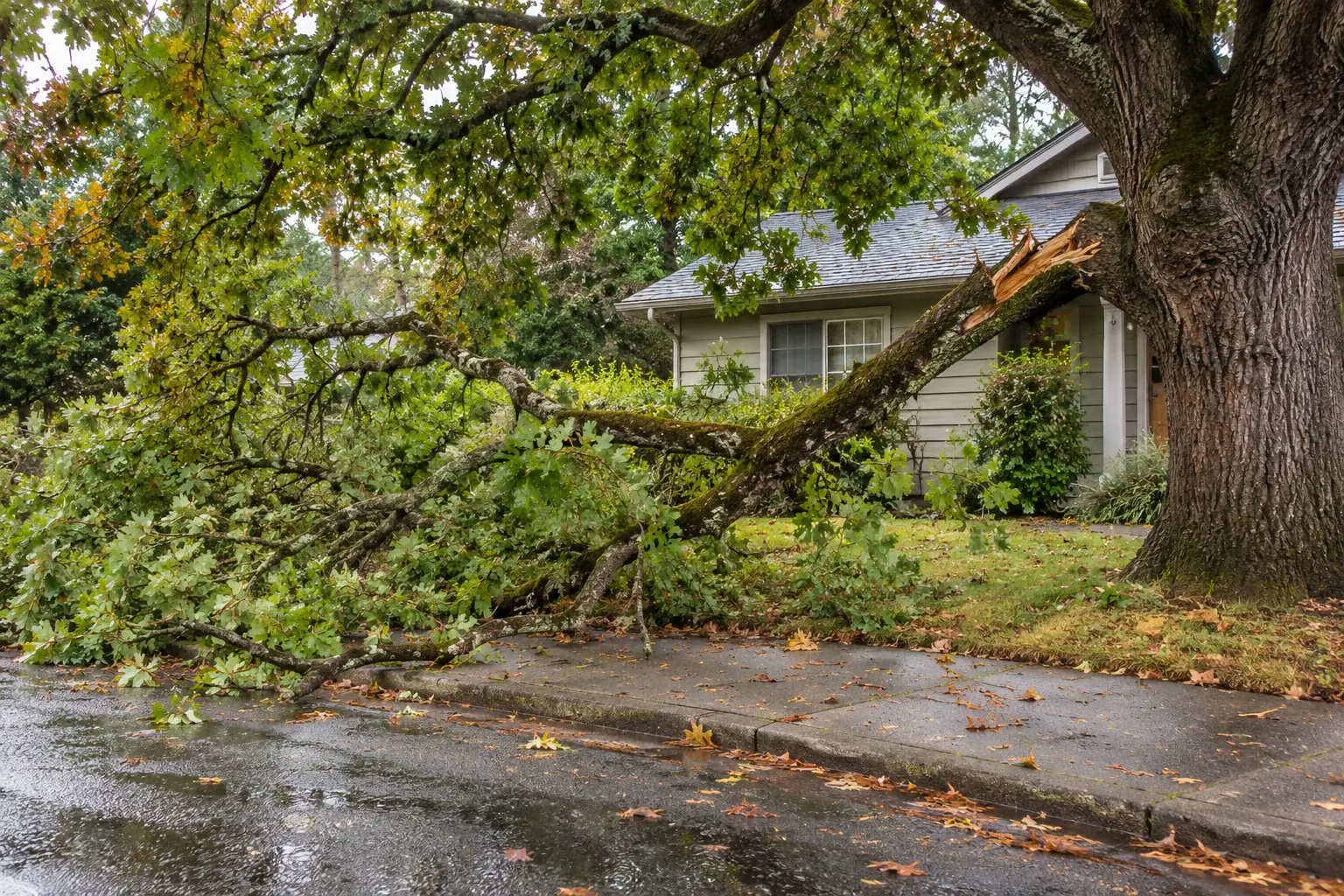
Homeowner insurance may help pay when a tree falls on a covered structure, but terms vary. Confirm with your insurer. More is on the emergency tree removal page.
Costs that come from local rules
Some costs around Gold Hill come from rules rather than from the tree itself, and they are easy to miss.
Trees near the Rogue River. Gold Hill code says vegetation and tree cover will be retained within 75 feet of the top of the Rogue River bank, with limited exceptions (Section 17.49.040 of Title 17). Removing non-native plants in that band calls for a landscape plan. That plan, and any restoration planting, is an added cost.
Erosion control. Section 17.50.020 of the same title requires an erosion prevention and sediment control plan before certain building or grading permits are approved. That includes 500 square feet or more of disturbance on slopes of ten percent or greater. If your tree work is part of a permitted project, ask the city what applies.
Fire season limits. ODF's 2026 regulated closure proclamation bans power saws at extreme fire danger and limits their hours at moderate and high danger. A one-day job in spring can become several shorter visits in August. The fire season tree work guide has the schedule.
Disposal. In fire season, Jackson County bans open and barrel burning, per its open burning page. That makes chipping or hauling the usual choice in summer.
For all the rules in one place, see the Gold Hill tree rules guide.
Reading the quote you get
A solid quote spells out each item you are buying, which lets you hold it up against a second quote item by item. Ask for one before work starts, and check for these items:
- Which trees. Each tree named or marked, with its location.
- The method. Felled whole, taken down in sections, or with a crane.
- Cleanup. Whether brush is chipped, whether chips stay or go, and whether logs are hauled or left in rounds.
- Stump. Whether grinding is included, and how deep.
- Damage terms. What happens if a lawn, fence or driveway is damaged.
- Payment. Total price, any deposit, and when the balance is due.
- License. The company's CCB number, which you can check on the Oregon CCB license search.
Oregon requires a CCB or LCB license for tree removal and stump grinding, according to the Landscape Contractors Board. Ask for proof of insurance too. You are free to get more than one estimate.
Sample cost scenarios
These examples show how the same national ranges play out on different kinds of Gold Hill property. They are illustrations, not quotes.
- A 25-foot ornamental tree in a flat backyard in town, with a wide gate. Likely near the low end of the small-tree range, since it can be cut and carried out quickly.
- A 60-foot oak leaning over a house on a hillside lot. Likely toward the top of the medium or large range, or above it, since every piece must be roped down and the slope limits equipment.
- A large pine in an open pasture outside town. Possibly less than its height suggests, if it can be felled whole and the wood left on site.
- Several trees near the Rogue River bank. Hard to price until the city confirms what may be removed under the 75-foot retention rule.
Frequently asked questions
What does one tree cost to take down in Gold Hill?
National 2026 guides put most single removals between a few hundred dollars and about $2,000, by height. Slope, access and what is under the tree change that a lot here. The company's written estimate is the real price.
Is the estimate free?
The call to (541) 855-3080 is free, and so is the referral. Quoting is the tree company's side of things. A routine job is quoted for nothing more often than not, yet this site cannot promise that on its behalf. Before you hang up, learn whether the visit carries any charge.
Why do oaks cost more to remove?
Oak is a dense, heavy hardwood. Cost guides note hardwoods can cost more than softwoods, since cutting and hauling take longer. Big oaks also tend to spread wide, which can mean more rigging.
Does stump grinding cost extra?
Grinding is usually priced separately unless the estimate says it is included. A 2026 national guide puts stump grinding at a typical $131 to $438 per job. Ask for it in the same quote to save a second trip.
Will a permit add to the cost?
The city code reviewed for this site does not show a general tree permit for private lots, but work near the Rogue River or tied to a grading permit can bring added steps. Ask Gold Hill City Hall at (541) 855-1525.
Can I get a lower price by doing the cleanup myself?
Doing some of the work yourself can help. Keeping the wood in rounds or hauling brush yourself can lower the bill. Tell the company before it writes the estimate.