Thinking about taking a tree down in Jacksonville? Phone (541) 855-3080 and you will reach one separate tree business carrying an Oregon CCB license. Three questions for it: does it take work in the historic town and its wooded hills, what is the city likely to require for your tree, and will it put its estimate on paper? Many large trees in Jacksonville need a city permit first, so start early.
Jacksonville, briefly
Jacksonville is an incorporated city in Jackson County, home to 3,020 people in the 2020 Census. From the Census Bureau's map points, it lies roughly 9.5 miles south and a bit east of Gold Hill in a straight line. The city's own development code states plainly that Jacksonville is a National Historic Landmark, and a Historical and Architectural Review Commission, known as HARC, reviews many changes inside the landmark district.
The two places share a road history. Historic Jacksonville notes that regular stage service began in the mid-1850s with stops at Ashland, Jacksonville and Rock Point, near Gold Hill.
The town also has its own protected woodland. The Jacksonville Woodlands Association grew out of a 1989 effort to save the 21-acre Beekman Woods after it went up for sale, and its later work brought other parcels, such as the Zigler property along Highway 238, under city ownership.
Jacksonville tree removal rules
Jacksonville protects "resource trees," and a 12-inch trunk is the cutoff. Under the city's Development Code (Titles 15 to 18), Section 18.18.020, a live tree counts as a resource tree once its trunk reaches 12 inches across at a height of 4 feet. The rules cover topping as well as cutting, and the code's definition of removal includes taking out a quarter or more of a tree's crown, trunk or roots.
The code allows a live resource tree to come out when any one of the following is true:
- Collapse is likely and the tree threatens health and safety.
- Taking it out is needed to protect a historic structure, a primary home or a commercial building.
- The Fire Chief has ruled it a fire hazard.
- Disease or blight has gone far enough that the tree may not survive.
- It stands where a planned building envelope, street, driveway or parking area must go, and no alternate design can work around it.
How you apply depends on the zone:
| Where the tree is | What the code requires |
|---|---|
| Historic Core, General Commercial or Artisan zones, or land under the riparian and wetland rules | A Tree Removal Permit with public notice, a scaled site plan and the fee |
| Residential zones (not Hillside or Special Protection) with no other development review | An administrative permit from the Planning Director, with the fee and any arborist opinion asked for |
| Hillside Residential and Special Protection zones | The separate standards in Section 18.20.080 |
No fee is charged when the Planning Director finds a tree could collapse at any moment, though you may have to pay for an arborist's opinion. Nuisance species named in the code also skip the fee. Among them are tree of heaven, cottonwoods, poplars, aspens and Leyland cypress.
Every tree cut is to be replaced with a fire-resistive tree no smaller than 1.5-inch caliper, one for one, except where the Planning Director grants a waiver. The section was last amended in December 2023. Call the Jacksonville Planning Department before you book a date, since the city decides which rule fits your lot.
Hillside lots and wildfire rules
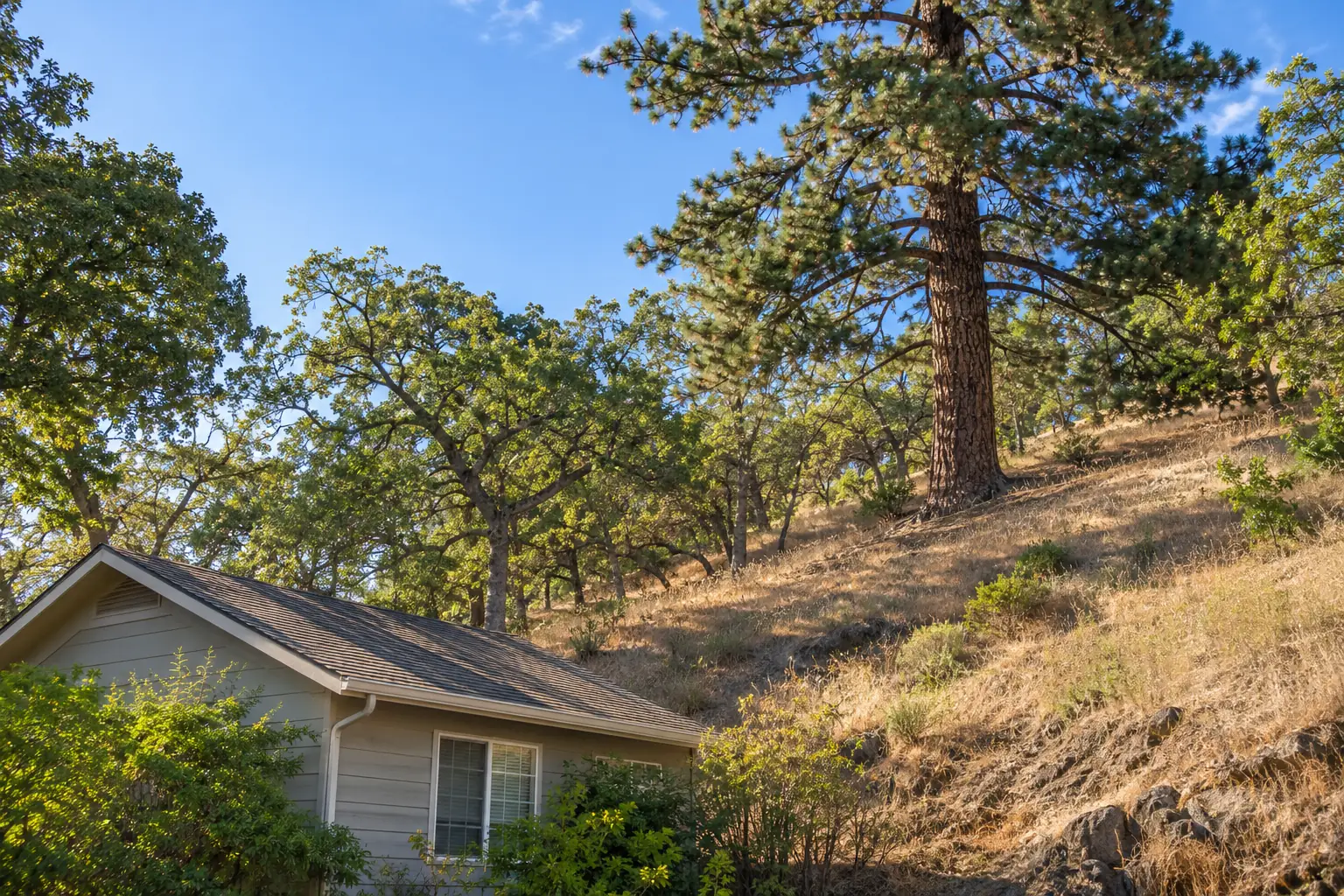
Jacksonville has hillside zones, and the city treats them differently from the rest of town. Hillside Residential and Special Protection lots are governed by Section 18.20.080 rather than the general tree section. Steep ground also changes how the work gets done, since a crane or bucket truck may not reach and wood has to be lowered rather than dropped. The guide to hillside tree removal covers what to expect on a slope.
Properties on the city's Urban/Wildland Interface map fall under the overlay district in Chapter 17.40 of the same code. In that overlay, driveways are to be built and maintained with a 12-foot all-weather surface and 13 feet 6 inches of vertical clearance for fire trucks, and vegetation is kept at least 10 feet clear of chimneys. If branches have grown down over a long driveway, that clearance standard is a good reason to have them cut back, and a tree company can do that at the same visit.
Big old trees near historic buildings
In the landmark district, a large tree can stand close to an older house or a stone wall the owner wants left untouched. Taking that kind of tree down usually means climbing it and lowering each section on ropes. Ask the company how it will protect the roof, the yard and anything historic underneath, and whether it plans to grind the stump or leave it.
The page on large tree removal covers what goes into taking down a big tree. For pricing, the Gold Hill tree removal cost guide explains the usual cost factors. Trust the written figure from whoever actually walks your lot.
Using the referral service from Jacksonville
You call (541) 855-3080 for free, describe the tree and give your Jacksonville address. Your request then goes to one separate tree business carrying an Oregon CCB license. After that handoff, the site visit, the estimate and any permit questions are between you and that business, so raise all three once it makes contact. Ask for the CCB number and check it with the Oregon CCB before agreeing to work.
For the city to the northeast, open the Central Point page. For the river valley out Highway 238, open the Applegate page. Every covered area is listed on the home page.
Frequently asked questions
What size tree needs a permit in Jacksonville?
Any live tree whose trunk is 12 inches or wider at 4 feet up is a protected resource tree. Your zone decides whether cutting one needs a Tree Removal Permit with public notice or an administrative permit from the Planning Director. On Hillside and Special Protection lots, Section 18.20.080 sets the terms.
Can I remove a dangerous tree in Jacksonville without paying a permit fee?
Yes, when the tree could fall at any moment and clearly endangers people or property. In that situation the Planning Director waives the fee, although you might be asked to pay for an arborist's review.
Is a replacement tree required in Jacksonville?
In most cases. Plan on one fire-resistive tree, 1.5-inch caliper or bigger, per tree cut, unless the Planning Director waives it or a different law overrides the section.
Does the fire department have a role in tree removal in Jacksonville?
It can. A tree the Fire Chief determines to be a fire hazard meets one of the code's removal criteria, and state or local fire prevention rules that require removal take precedence over the tree section.